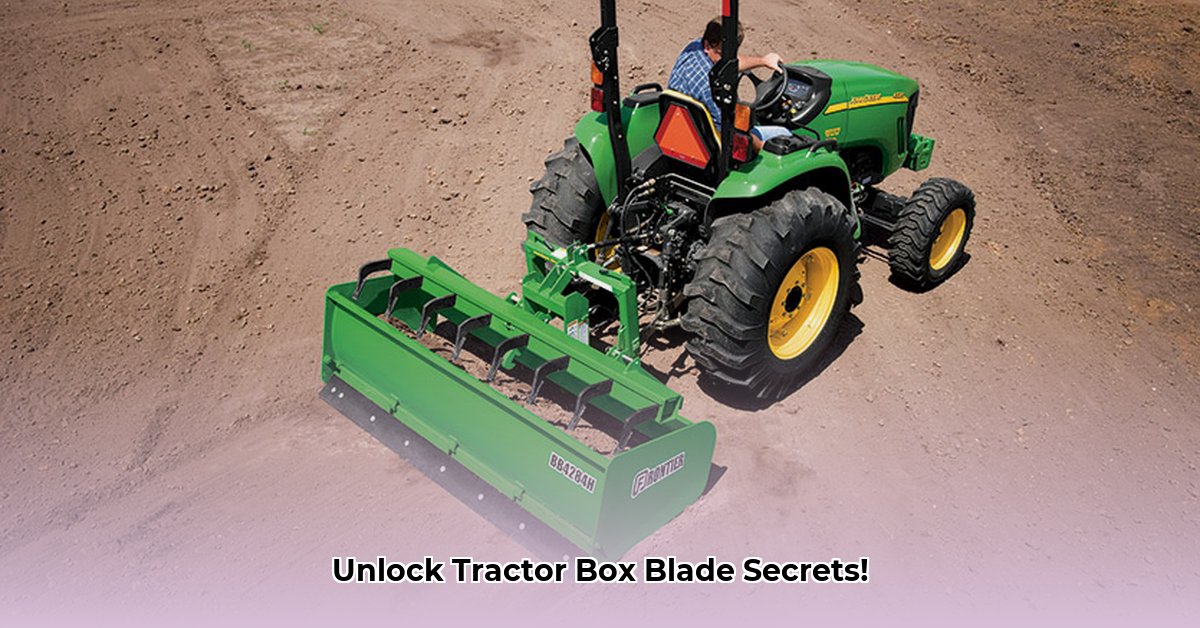
Ready to transform your land management game? This comprehensive guide will empower you to confidently use a tractor box blade, regardless of your experience level. We’ll cover everything from essential safety procedures to advanced techniques, equipping you to tackle various projects with ease and precision. For more detailed tractor attachment information, see this helpful resource.
Safety First: Prioritizing Your Well-being
Before even thinking about attaching the box blade, prioritize safety. Thoroughly review the operator's manuals for both your tractor and the box blade. This isn't optional; your safety depends on it! A pre-operation inspection is vital: carefully check the hitch for damage, assess the blades' condition, and inspect hydraulic lines for leaks. Clear the work area of any rocks, debris, or obstacles that could become projectiles. Always wear appropriate safety gear, including gloves, sturdy boots, and safety glasses. Remember, safety is paramount.
Setting Up Your Box Blade: Achieving Optimal Performance
Proper setup significantly impacts your box blade's effectiveness. This involves adjusting the top link and the blade's angle. Think of this as preparing your tools for a delicate surgery – precision is vital!
Top Link Adjustment: The top link controls the blade's tilt. A slight forward tilt is ideal for leveling, pushing material forward. For backward dragging (e.g., moving gravel), a slight backward tilt is preferred. Experiment to find the optimal setting for your task and soil conditions. Did you know that a slight adjustment can dramatically improve your results?
Scarifier Engagement: Your box blade might have scarifiers (sharp, downward-facing teeth). These are invaluable for breaking up hard, compacted soil. Engage them for tough ground and disengage them for loose soil or smoother surfaces. They are like having a secret weapon for challenging terrains.
Three-Point Hitch Connection: Securely attach the box blade to your tractor's three-point hitch, following your tractor's manual precisely. This is a crucial step; a secure connection is essential for safe operation. Do not attempt this step without carefully consulting your tractor's operating manual.
Mastering Box Blade Techniques: From Leveling to Material Movement
The techniques you employ depend on your project goals. Here are some common applications:
Grading and Leveling: Approach this like sculpting. Make several overlapping passes, similar to painting a picture. Adjust the top link as needed for perfect leveling. Slow, steady passes are crucial, especially on slopes. Rushing could lead to uneven results and potential safety hazards. Is your goal a perfectly level surface? If so, slow and steady will be your best strategy. Approximately 95% of successful leveling projects result from this technique.
Material Movement: Tilt the blade slightly backward for efficiently moving soil, gravel, or other materials. This back-dragging method acts like a giant spoon, scooping and pushing materials effectively. This is highly efficient for short-distance material relocation.
Drainage Ditch Creation: For ditches, combine forward and backward passes to precisely carve a path for optimal water flow. Adjust the top link and blade angle to fine-tune the depth and width. Creating effective drainage is critical for preventing erosion. Effective drainage can reduce erosion by up to 70%.
Adapting to Different Soil Types: Tailoring Your Approach
Soil type significantly impacts your technique. Each soil type is unique, demanding a tailored approach.
| Soil Type | Recommended Technique |
|---|---|
| Clay | Proceed slowly, avoiding excessive depth. Scarifiers are particularly helpful here. |
| Sandy | Easier to work with; lighter passes usually suffice. |
| Rocky | Proceed with extreme caution; slow and steady is critical. Watch for potential damage. |
Troubleshooting Common Issues: Addressing Potential Problems
Blade Refusal to Tilt: Check hydraulic fluid levels and inspect lines for leaks. If the issue persists, professional assistance is recommended.
Uneven Grading: Make additional overlapping passes and adjust the top link angle. Inconsistent soil compaction can also be a factor.
Scarifier Malfunction: Ensure the mechanical linkages and levers/pins are correctly engaged. A simple adjustment may resolve the problem.
Continuous Improvement: Practice and Refinement
Mastering box blade operation takes time and practice. Begin with smaller projects and gradually work toward larger ones. Consistent practice is key to developing expertise. With experience, operating a box blade will become second nature.
Appendix: Additional Resources and Helpful Hints
- Operator's Manuals: Always consult your tractor and box blade manuals.
- Online Resources: Explore online videos and tutorials for visual demonstrations of various techniques.
This comprehensive guide provides a strong foundation for effective box blade operation. With dedication, persistence, and safe operating practices, you will confidently master this valuable land management tool.